
Glendora Voter Lookup Fields
Glendora voters use the LA County Voter Registration Status tool when they need to verify their own registration. The lookup is strict because it checks a known voter record rather than browsing a public list. The form asks for last name, birthdate, residence house number, and ZIP code. LA County also lists voter assistance at (800) 815-2666, option 2, for voters who cannot complete the online check.
| Lookup Field | Entry Type | Required | Format Notes |
|---|---|---|---|
| Last Name | Text | Yes | Alphabet characters only. |
| Birthdate | Date text | Yes | Use mm/dd/yyyy format. |
| House Number | Number | Yes | Use the house number of the residence address. |
| ZIP Code | Number | Yes | Numbers only. |
| Submit | Button | Yes | Runs the status check. |
The required fields explain the main voter-registration myth for Glendora: this is not a public name search for all local voters. A person who only has a name will not get a browseable voter roll from the status tool. Third-party access moves to the LA County request process and California Elections Code limits.
Glendora Voter Status, Not Roll Browsing
The county status screen is best understood as a verification service. It can help a voter check whether the registration on file matches the voter's current residence facts. It is not built for genealogy, skip tracing, or public browsing. That design reflects California's split between voter participation in public elections and the privacy of registration affidavits.
The distinction also affects Glendora people search work. If the goal is to verify a current voter, the person being checked must have the right private facts for the online form. If the goal is permitted research using voter records, the request must go through LA County or the California Secretary of State. For general access-law context across other record sets, use the Glendora public records search page instead of treating the voter tool like a CPRA portal.
The LA County voter information request page is the county path when the status lookup is not enough. It lists a voter-registration file search fee by name and gives mail and in-person instructions through the Registrar-Recorder/County Clerk.
California Voter Records Inventory
A California voter record can carry enough facts to identify a voter, assign districts, and manage elections, but not every field is public. The voter file may include name, residence address, mailing address if different, registration date, party preference, status, precinct, districts, vote-by-mail status, and participation history. Participation history means whether a voter took part in an election. It does not show ballot choices.
| Name | Available only for permitted voter-file uses, not open personal browsing. |
|---|---|
| Residence address | Restricted from routine public lists and protected further for confidential voters. |
| Mailing address | Part of restricted voter-file access when released for a permitted purpose. |
| Party preference | California registration can include party preference in voter-file data. |
| Precinct and districts | Used for election administration and local district identification. |
| Vote history | Shows participation only, never how a ballot was marked. |
| Signature | Confidential except for specified legal access. |
Confidential by law. California Elections Code sections 2188 and 2194 protect registration-affidavit information from routine public display, including signature data, full identification numbers, full birthdate details, and protected voter information.
LA County Voter File Steps
Glendora voter registration records for file-search purposes are handled by the LA County Registrar-Recorder/County Clerk and, for statewide file access, the California Secretary of State voter-registration information file request process. LA County lists "Search - Voter Registration File" at $5 for each name searched. The request is not a casual search box. It requires requester identity information and a lawful purpose.
| Step | What LA County Requires | Why It Matters |
|---|---|---|
| Choose the channel | Visit the Election Information Section or mail a written request. | County staff process the search, not the public status tool. |
| Identify the requester | Name, address, birth date, signature, and telephone number. | The office needs the requester tied to the request. |
| Include return mail | A self-addressed stamped envelope is required for mail requests. | LA County uses it to return the response. |
| Name the voter search | Provide the name to be searched and the required fee. | The listed fee is $5 per name searched. |
| State the purpose | Election, scholarly, journalistic, political, or governmental use. | California law bars personal, private, and commercial use. |
The mail address in the research is Registrar-Recorder/County Clerk, Election Information Section, 12400 Imperial Hwy., Room 2013, Norwalk, CA 90650. Glendora has no separate city voter-file office for this county record set.
Glendora Voter Request Screens
The LA County request page at Request Voter Information shows the county route for voter-registration information requests and the per-name search fee.
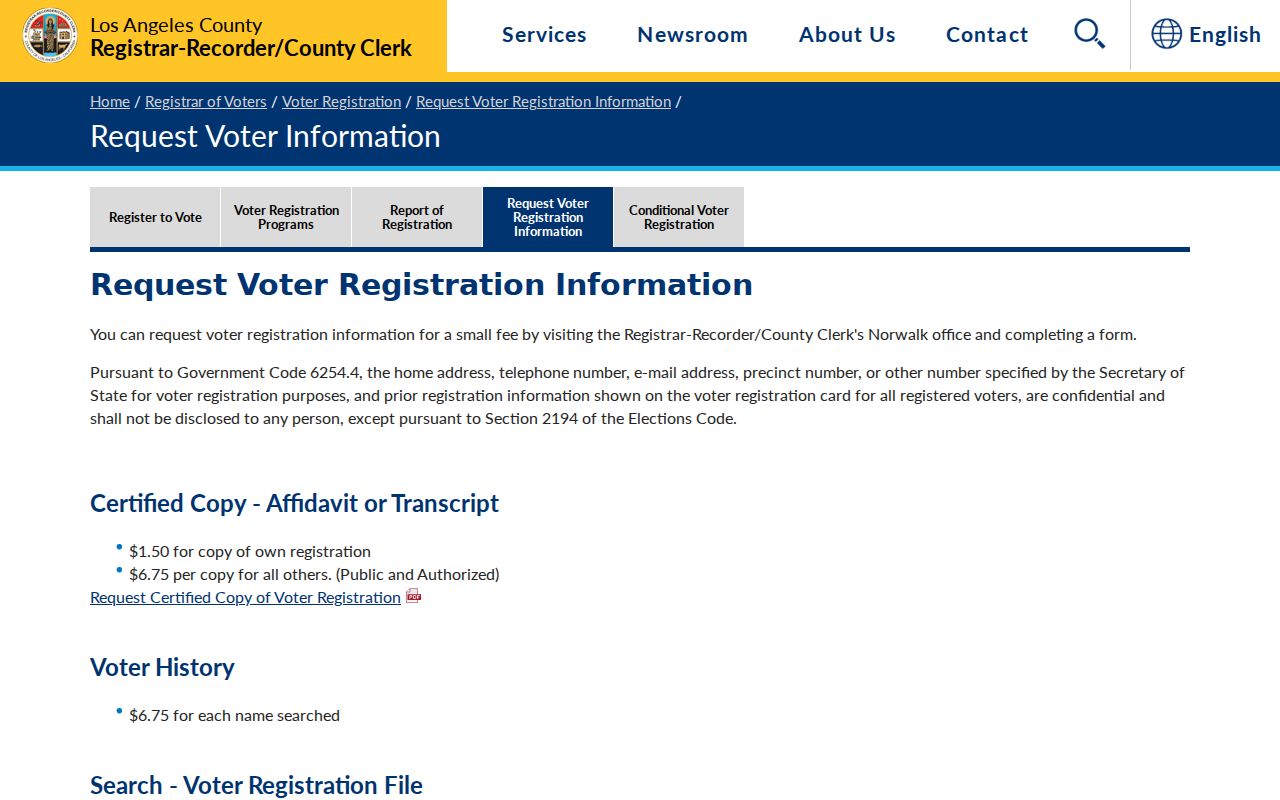
That county screen is the practical place to confirm whether a Glendora voter-file search must be mailed or handled in person through the Election Information Section.
The Secretary of State page at Voter Registration Information File Request gives the statewide rules for voter-file access and permitted purposes.
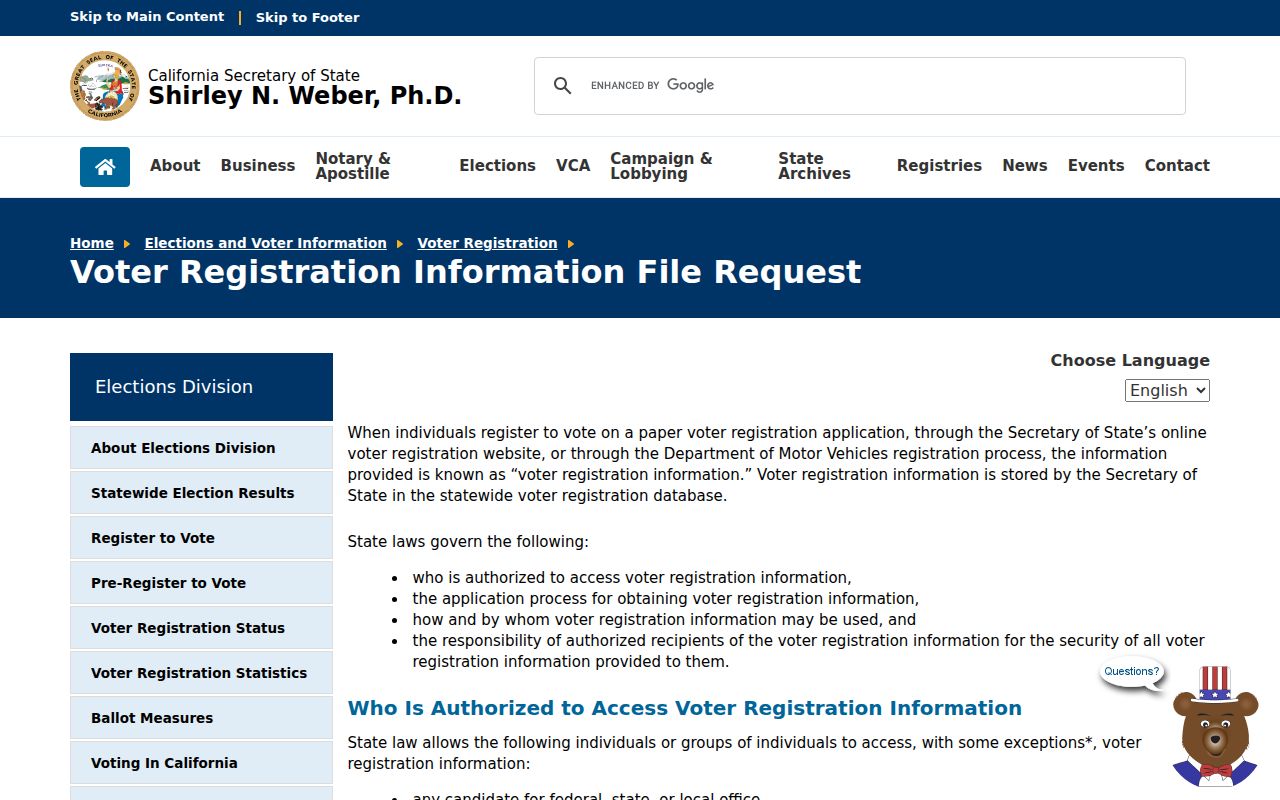
Use the state screen to check the California-wide context before assuming that a Los Angeles County voter record can be copied or reused.
Glendora Voter Registration Use Limits
Elections Code section 2194 is the main use-limit rule for Glendora voter records. It bars personal, private, and commercial use of voter-registration information. The permitted buckets listed in the research are election, scholarly, journalistic, political, or governmental purposes, as determined under state rules. That is a narrower standard than ordinary curiosity or general people-finding.
Misuse can also cross into broader California legal problems. The research flags stalking, harassment, doxing, identity theft, and address misuse as record-use risks, with Penal Code section 646.9 and civil harassment remedies under Code of Civil Procedure section 527.6 as related California protections. Voter-file misuse is specific because the voter statute itself limits purpose and release.
Use limit. A Glendora voter roll is not a commercial lead list or a private address list; the elections office controls release under state law.
Safe At Home Voter Records
California's Safe at Home program is a major reason a Glendora voter record may not show a normal residence address. The Secretary of State administers the confidential address program and provides a substitute mailing address accepted by state, county, and city agencies. The research notes that the program began in 1999 after 1998 legislation and originally helped domestic-violence victims keep address and voter records confidential.
Safe at Home now covers several protected groups described in the research, including victims of domestic violence, sexual assault, stalking, human trafficking, child abduction, and elder or dependent adult abuse, plus certain public entity staff and reproductive health care workers who fear for safety. A Glendora voter using the program may have address information withheld or substituted across official systems.
Glendora Voter Roll Status Changes
A voter record is not static. California voter records can become inactive or cancelled after address-confirmation mail, returned mail, a voter request, death notice, duplicate registration, or list-maintenance rules. The status lookup may help a voter see a current registration problem, but it is not a third-party audit tool.
For Glendora research, status terms should be read with care. An inactive record may point to an address issue rather than a person leaving the area. A cancelled record may reflect a new registration, death information, or another statutory maintenance event. When the voter trail ends, move to permitted requests, court probate records, deed transfers, or historical directories rather than guessing from one status result.
Note: Voter participation records show election participation only and do not disclose ballot choices.
Historical Glendora Voter Registers
Modern Glendora voter registration is privacy-heavy, but older voter records can be rich genealogy sources. The California State Archives local-government records include Great Registers, the historical voter-registration lists. Depending on era, these registers can identify voters by age, occupation, birthplace, residence, naturalization status, and registration date.
The historical context matters for Glendora. The city was founded in 1887, incorporated in 1911, and remained tied to citrus and railroad-era growth before postwar residential development. Early voter lists may reflect Los Angeles County place names such as Alosta, Charter Oak, Azusa Township, or San Gabriel Valley rather than only "Glendora." Search those names when a modern city-only search misses an older resident.
When Glendora Voter Records Stop
A Glendora voter trail can stop for lawful reasons. The voter may be protected by Safe at Home, the requester may lack a permitted purpose, the record may be inactive or cancelled, or the facts entered in the status lookup may not match the registration. The right response is to change record sets, not force the voter file.
For a lawful family-history or civic research trail, use historical Great Registers, Glendora Public Library local publications, Los Angeles-area city directories, probate filings, deeds, or official institutional directories. For current voter-file access, stay with LA County RR/CC or the California Secretary of State. The limits are part of the record system, not a sign that the record never existed.
The CA.gov Megan's Law service page appears in the manifest as a separate California public-safety service with its own legal-use screen and daily-update notice.
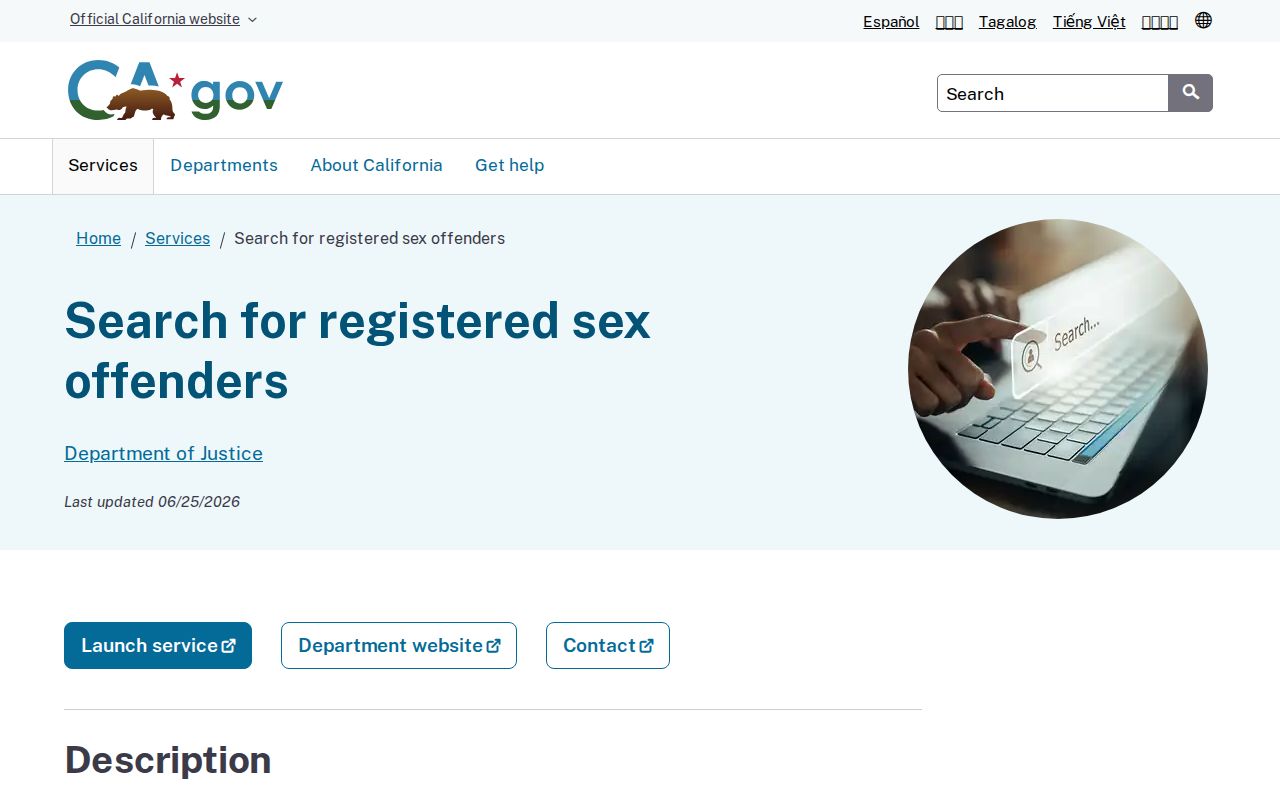
That public-safety screenshot is not a voter-roll substitute; it illustrates why each California lookup must be used only within the limits of its own custodian and statute.